
Av Hernesto Che Guevara y Av 16 de Abril, Azogues, Ecuador, Azogues, Cañar, 030102, Ecuador
Lab tags:
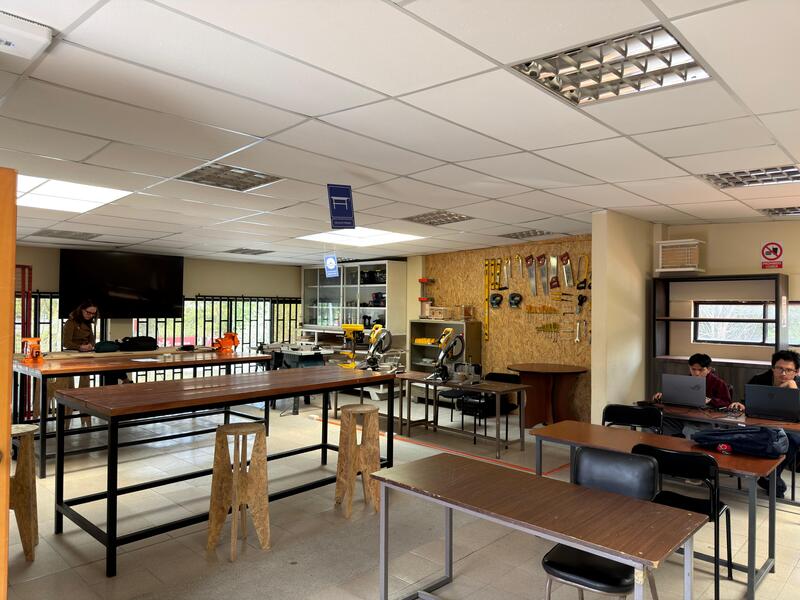
FabLab UCACUE-Azogues is a model-making and fabrication laboratory located at the Azogues campus of Universidad Católica de Cuenca, Ecuador. Open to the public since March 2026, it provides a space for exploring architecture and form through direct engagement with materials, tools and fabrication processes. Its activities connect design thinking with the construction of physical models, objects and prototypes, allowing users to test different possibilities and understand how a proposal takes physical shape.
The laboratory also serves as a meeting place for the university community, particularly architecture students. Its welcoming, relaxed atmosphere encourages conversation, the spontaneous exchange of knowledge and the freedom to ask questions, test alternatives and pursue individual interests. Within this setting, users can develop their own approaches to thinking and making, share their progress and discover new perspectives through the work of others. Public access extends these opportunities for exchange and collaboration to people with different interests and backgrounds.
The FabLab’s philosophy is grounded in DIY —Do It Yourself— culture and learning through practice. This approach encourages users to imagine, test, build and revise their proposals independently, drawing on what they discover during fabrication. Experimentation helps them understand the possibilities and limitations of materials, become familiar with tools and make design decisions informed by the production process. Testing and adjustment are integral to learning and provide opportunities to reconsider an idea.
This independence develops alongside coworking and teamwork. Sharing a fabrication space supports the exchange of skills, collaborative problem-solving and the development of knowledge through experience. Each participant contributes an individual perspective, while collaboration allows challenges to be approached from different angles and projects to benefit from shared input.
Architectural and formal exploration centres on the relationship between design, material and fabrication. Physical models and prototypes enable users to investigate geometry, proportions, spatial relationships, components and assembly methods. Making an object allows design decisions to be observed, compared and refined in tangible terms. Fabrication therefore becomes part of the design process from its earliest experiments.
To support these activities, the laboratory combines digital fabrication equipment with workshop tools. Its main equipment includes:
- Three Creality Ender-3 V3 KE 3D printers: used to turn digital models into physical parts, scale models and prototypes, supporting geometric exploration and the comparison of design alternatives.
- One full-sheet CNC router: supports computer-controlled cutting and milling, enabling the fabrication of components from digital designs and the exploration of parts and assemblies.
- Two Bosch GTS 254 Professional table saws and two DeWalt DWS715 305 mm compound miter saws: provide straight and angled cutting capabilities for model-making, woodworking and prototype construction.
- Four jigsaws, comprising two Bosch GST 750 Professional units and two Wesco WS2933 cordless units: support cut-outs and curved profiles. They are complemented by two Bosch GKS 150 Professional handheld circular saws for additional cutting tasks.
- One Stanley SBT2513 bench drill press: supports drilling with the workpiece held on a fixed platform. Hammer drills and cordless drill drivers are also available for drilling, assembly and fastening tasks.
- Two Bosch GEX 125-1 AE Professional random orbital sanders and two DeWalt DWE6411 quarter-sheet sanders: support surface preparation and finishing. Two Bosch GHO 700 electric hand planers complement this equipment for shaping and adjusting wooden components.
- Two PTK 2 HP air compressors and two Truper CLNE-18 pneumatic nailers: support assembly and fastening processes. The workshop also includes angle grinders for material removal and finishing, depending on the material and accessory used.
- Laser CO2 100W, 90cm x 60cm, with noise controller
- Two Cameras Sony ILCE-5700
- 3D Scaner 3DMakerpro Moose Lite
- Lidar 3D Scaner Makerpro JMK2000737
- Drone DJI Mavic 4 Pro
Together, these resources allow users to combine different techniques within a single project: developing digital geometry, fabricating components, making manual adjustments and evaluating the outcome through a physical model. FabLab UCACUE-Azogues provides an environment where freedom to explore is supported by practical experience, shared knowledge and collaboration among people who learn through making.
Links
- Stampa 3D
- Fresatura CNC
- Incisione e taglio laser


